






















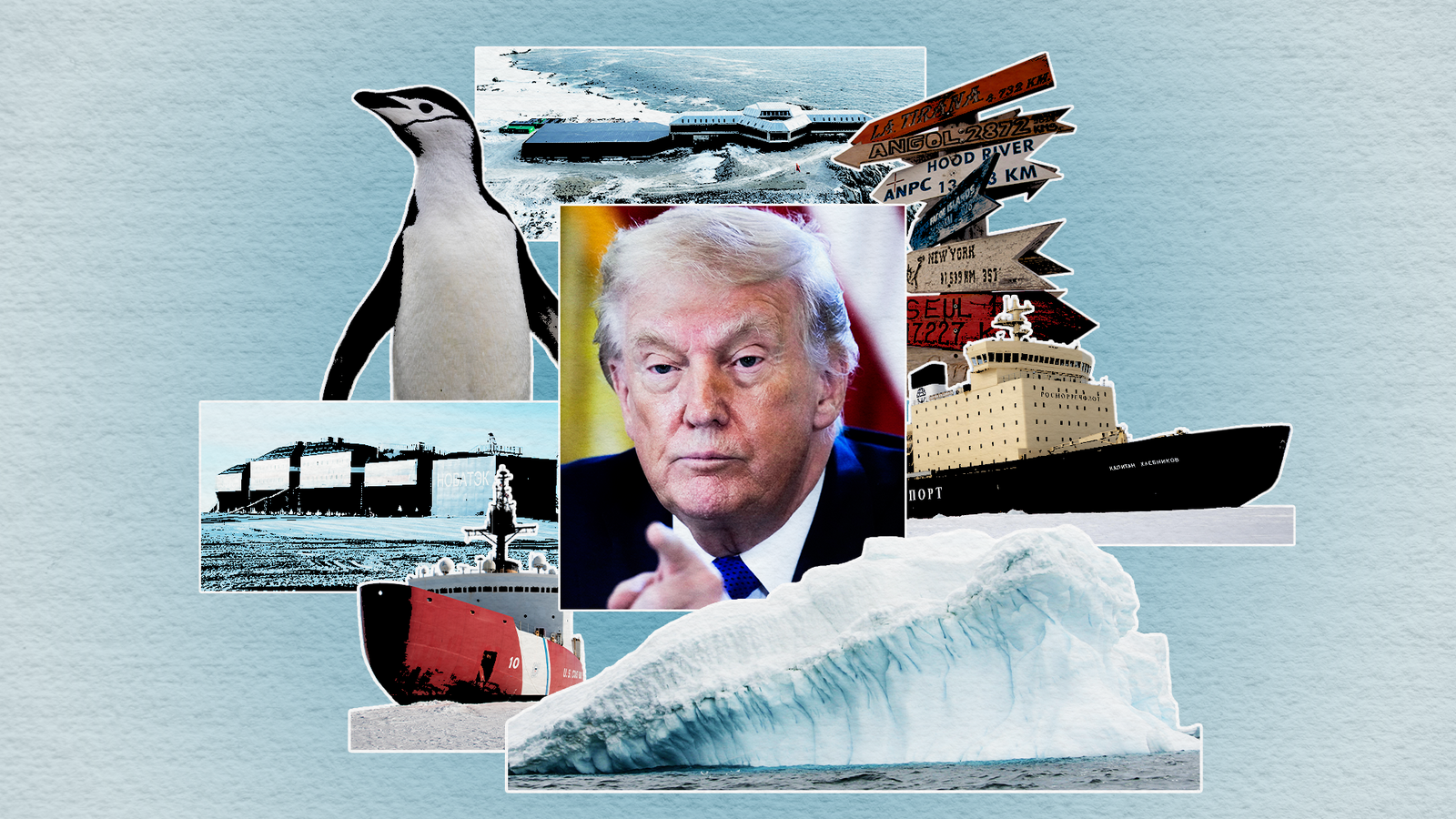
Trump’s Cuts Leave US Influence in Antarctica Vulnerable to Rivals
As former President Donald Trump’s focus on Arctic ambitions continues, the United States seems to be inadvertently ceding its influence in Antarctica. Significant reductions in funding for climate-related research threaten the scientific presence that traditionally allows countries to maintain their foothold on the icy continent.
Concerns Over Research Cuts
Professor Ted Scambos, a glaciologist from the University of Colorado and an expert in Antarctic research, has labelled the proposed cuts to climate-focused scientific initiatives as “catastrophic.” These cuts come at a time when rapid melting in the Antarctic raises urgent questions about climate change.
The implications of reduced scientific funding are severe. Research activities are central to how nations assert their influence in Antarctica. While territorial claims by the UK, Argentina, and several other countries remain suspended under the 1959 Antarctic Treaty, scientific research has allowed countries to maintain their presence.
The Role of the UK
The UK has established research stations such as Rothera and Halley VI within its claim area, striving to balance its contributions to global science with the assertion of its territorial rights. Professor Dame Jane Francis, head of the British Antarctic Survey, noted that the UK’s presence in Antarctica serves dual objectives: upholding the Antarctic Treaty and ensuring scientific prowess.
Furthermore, the British research fleet, which includes the RRS Sir David Attenborough, is crucial for maintaining operations in the region. The UK’s commitment to leading scientific research in Antarctica contrasts sharply with recent US decisions.
Shifts in Geopolitical Influence
The current landscape is shifting, particularly as the US has decreased its Antarctic presence. Due to funding cuts, it has no dedicated icebreaker for Antarctic operations this year, relying instead on a lease from Ukraine. This unusual dependency highlights a potential shift in the balance of power in the region.
China, meanwhile, has been rapidly expanding its activities, establishing multiple research bases on the continent and commissioning new icebreakers. With five operational bases and plans for further expansion, Beijing is positioning itself to exert more influence in the Antarctic.
Implications for Future Governance
The Antarctic Treaty, which prohibits military or commercial exploitation of the continent, was created to assert the region’s status as a zone of cooperation and peace. However, as climate change accelerates and natural resources become more accessible, the stability of the treaty could be threatened. Countries like Russia have hinted at potential economic interests in Antarctic waters, raising concerns over the future of environmental protections.
Background
During the early years of the Antarctic Treaty, several nations, including the UK and Argentina, put forward territorial claims over parts of the continent. While these claims are currently “in abeyance,” scientific research remains an avenue for nations to establish their presence and assert influence.
The ongoing rise in global temperatures is exacerbating changes in the Antarctic, making it crucial for nations to balance scientific inquiry with geopolitical interests. With developments in the Arctic raising eyebrows about territorial ambitions, there is uncertainty regarding how long Antarctica will remain untouched.
As nations navigate the complexities of Antarctic governance, the UK must reassess its strategy to maintain its influence and ensure that the region remains safeguarded for scientific research and environmental protection.
Source: Original Article






