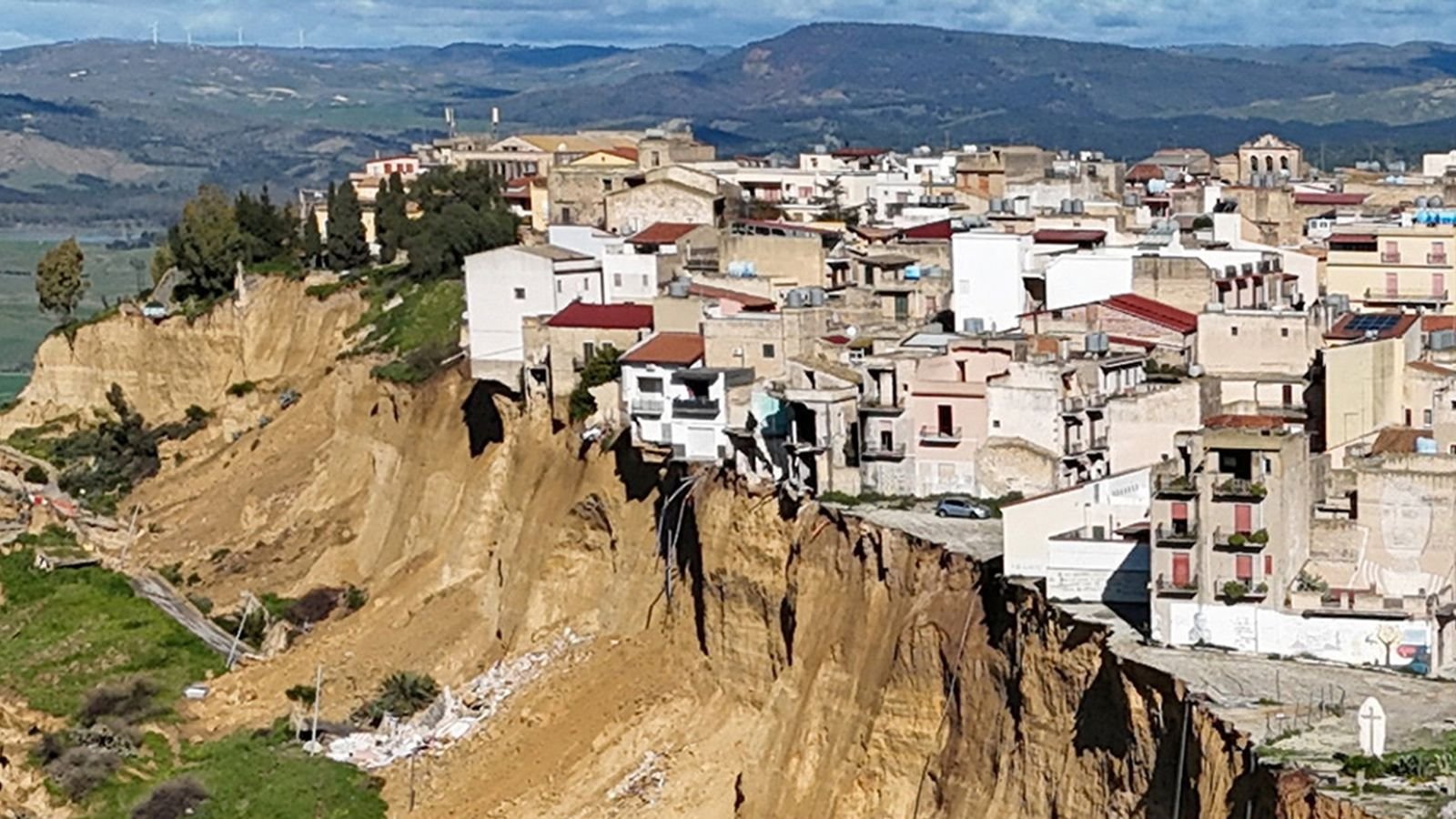
Landslide in Sicily Forces Evacuations
A severe landslide triggered by heavy rains in southern Sicily has led to the evacuation of over 1,500 residents as part of the town of Niscemi has collapsed. Authorities have estimated the damage to be around €2 billion (£1.74 billion), with concerns growing over the safety of the remaining structures.
Immediate Impact on Residents
On Wednesday, Italian Premier Giorgia Meloni inspected the affected areas, where numerous homes are precariously situated at the cliff’s edge. The landslide has already caused several buildings and vehicles to fall approximately 20 metres to the plain beneath.
The landslide extends over 2.5 miles (4km), prompting officials to establish a 150-metre-wide exclusion zone around the town. Many residents will have to seek long-term housing alternatives, as parts of Niscemi have been declared “uninhabitable” due to ongoing ground movement.
Fabio Ciciliano, Italy’s civil protection chief, remarked on the shrinking viability of certain residences, indicating that some families might have to be permanently relocated.
Government Response and Support Measures
In response to the disaster, the federal government declared a state of emergency for Sicily, Sardinia, and Calabria, allocating an initial €100 million (£86.9 million) for immediate aid and recovery efforts. Jessica Meloni viewed the scale of destruction from a helicopter while meeting with local leaders to discuss the situation.
Background on Niscemi’s Vulnerability
Niscemi, home to around 25,000 individuals, is particularly susceptible to landslides, built upon layers of sand and clay that easily give way in heavy rainfall. A similar incident in 1997 led to the evacuation of over 400 people, highlighting the historical risks associated with the area.
Professor Giovanna Pappalardo from the University of Catania noted that the current landslide is significant, affecting houses directly confronting the slope, and called attention to long-standing geological concerns over construction in such hazardous zones.
Political Fallout and Future Considerations
The disaster has reignited discussions on urban planning and safety, with opposition leaders such as Elly Schlein advocating for a reallocation of funds initially set aside for a contentious bridge project to instead facilitate rebuilding efforts in the flood-stricken regions.
This event underscores the need for careful consideration of environmental factors when planning residential areas, particularly in regions prone to extreme weather phenomena. The impact of Cyclone Harry, which preceded this landslide, further amplifies the urgency for strategic reforms in land management and community safety regulations.
Source: Original Article