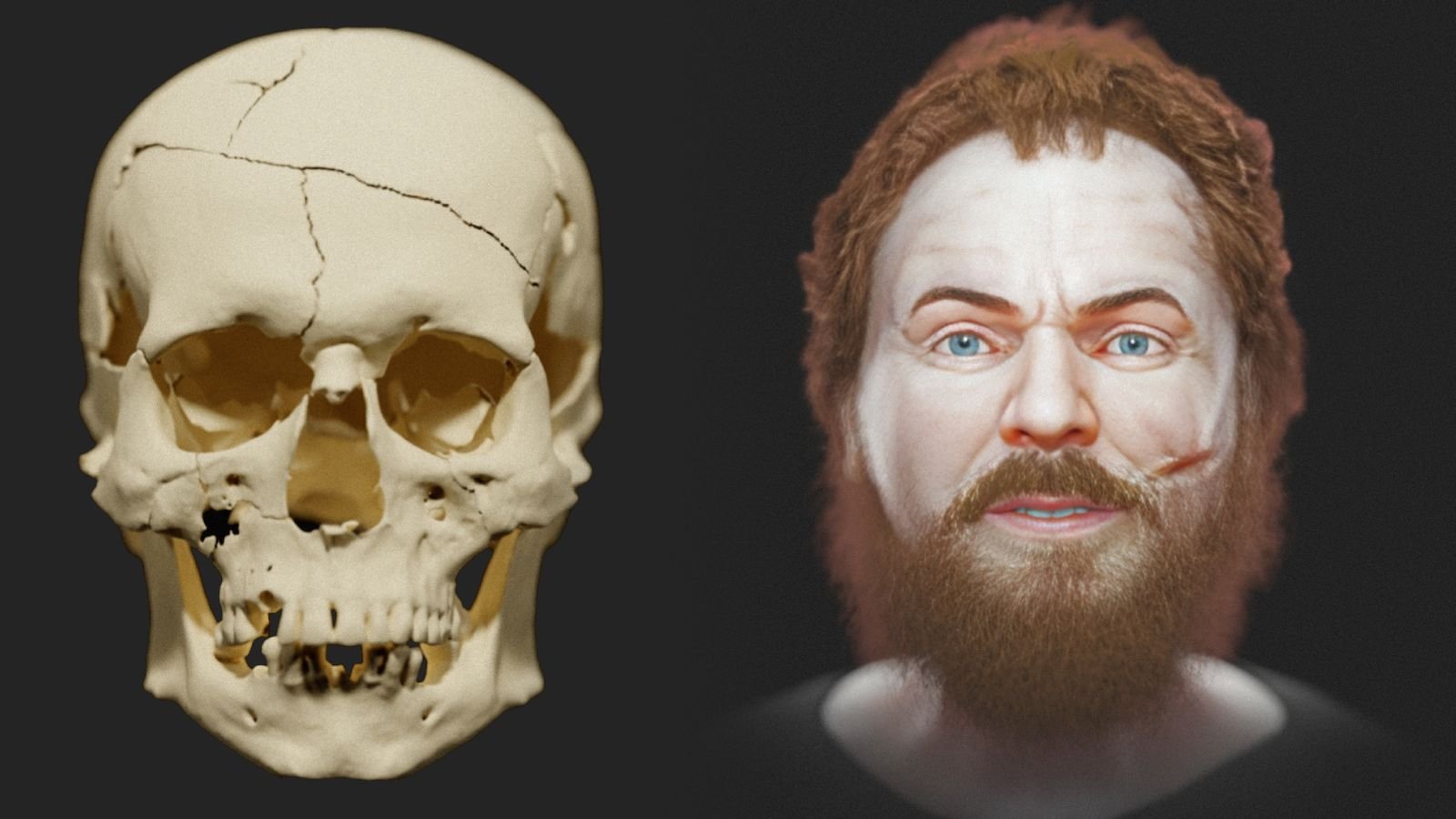
400-Year-Old “Vampire” Remains Revealed in Croatia
The façade of a man believed to have been perceived as a “vampire” over 400 years ago has been reconstructed for the first time. Unearthed from a grave in Racesa, Croatia, the remains were subjected to deliberate mutilation in an effort to prevent him from returning from the dead.
The Discovery
Archaeologists recently exhumed the skeleton from a site at Racesa, a historical fortress located in eastern Croatia. The body was discovered severed from its head, reburied face down, and weighed down by large stones—a burial practice commonly associated with preventing the deceased from returning as a vampire. Experts claim that these actions were likely not due to natural causes but were instead intentional measures taken during his lifetime to counteract concerns surrounding vampire beliefs.
Reconstruction of the Face
Using advanced imaging technology, scientists have managed to recreate the facial features of the long-deceased individual. The process involved virtually reconstructing the skull based on CT scan data. Cicero Moraes, a graphics expert, oversaw the reconstruction, employing various techniques to place facial features accurately and objectively. This reconstruction provided a vivid depiction that highlights the injuries he sustained during his violent life.
Insights from Archaeology
According to Natasa Sarkic, an archaeologist on the excavation team, the man may have instilled fear both in life and death due to his history of violence. Analysis indicates he experienced at least three significant traumatic incidents, resulting in facial disfigurement. Such features may have contributed to societal rejection and an assumption of supernatural menace, culminating in his posthumous treatment.
Beliefs About Vampirism
Dr Sarkic noted that individuals with violent histories or disfigurements were often thought to be at risk of turning into vampires upon death. In the Slavic tradition, it was believed that a soul remained tied to its body for a period after death, creating a window during which preventive measures could be enacted against possible vampiric return. These measures included various methods of desecration, such as staking or binding, which were employed to safeguard the community from purported threats.
Historical Context
This discovery aligns with a broader context of historic beliefs surrounding vampirism prevalent across Europe. Comparable grave sites featuring mutilated remains have been identified in other countries, including Poland, showcasing a widespread cultural phenomenon rooted in fear and superstition. The Racesa remains reveal insights into societal attitudes towards death and the supernatural during the 15th and 16th centuries.
A Final Note on the “Vampire” Remains
The man, who likely stood around 5 feet 4 inches tall and lived between 40 and 50 years, was found interred near a church within the fortress, though his position was notably marginal. Details indicate the decapitation was not executed cleanly, further contributing to the mystery of his burial. With the excavation of these remains completed in early 2023, it opens doors to discussions about humanity’s longstanding anxieties surrounding death and legacy.
Researchers continue to explore how such beliefs shaped social practices and influenced historical events, marking the Racesa excavation as an important find in the study of human culture and superstition across centuries.
Source: Original Article