






















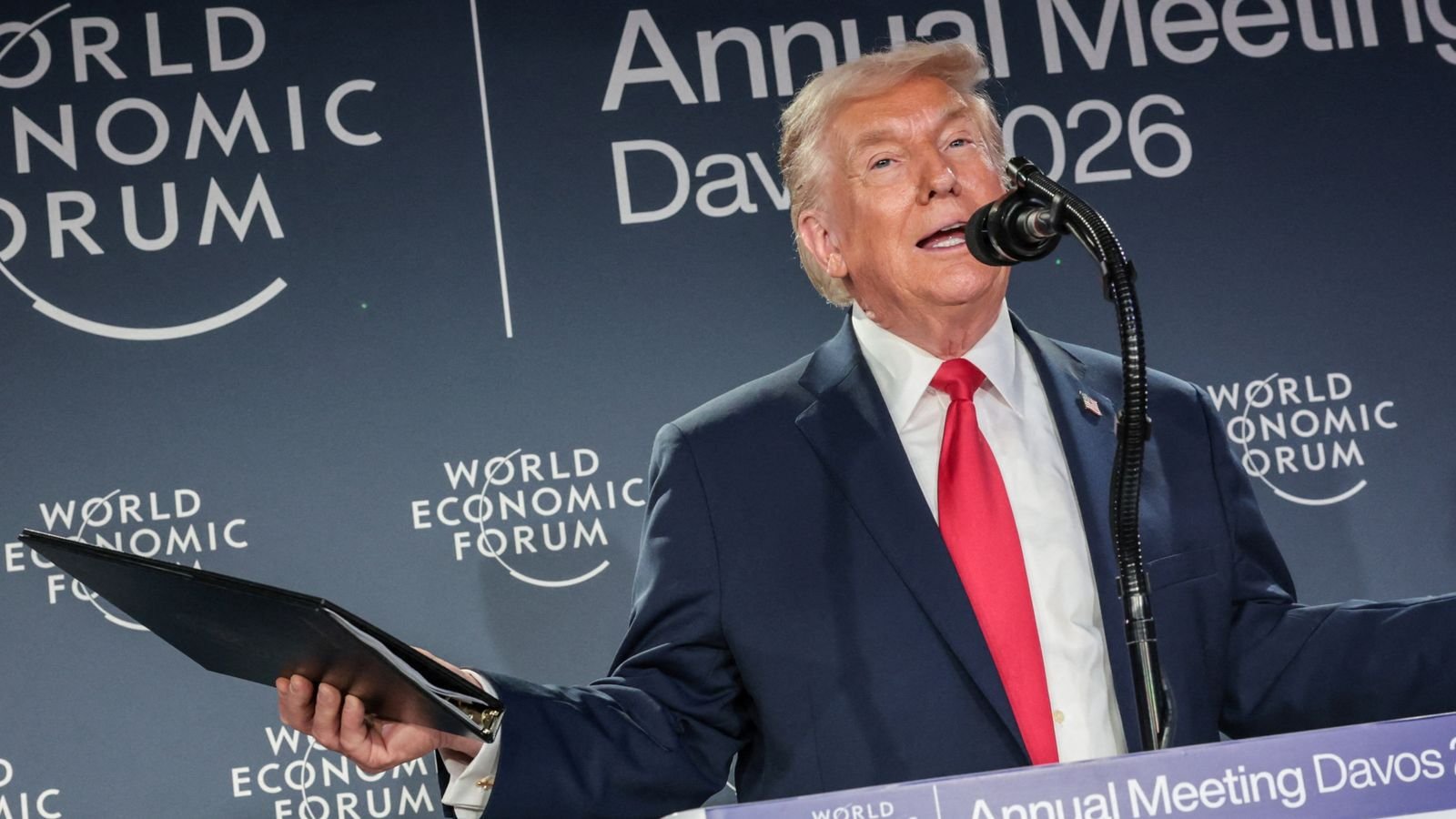
Davos Sees Economic Model Under Fire as Trump Takes Centre Stage
This week in Davos, Switzerland, the annual World Economic Forum (WEF) became a platform for intense scrutiny of Europe’s economic and political models. With former US President Donald Trump leading the largest American delegation to date, his presence overshadowed discussions, triggering discussions on geopolitical tensions and national policy shifts that may reverberate for years to come.
Trump’s Dominance and the Applause of Discontent
Trump’s participation was projected to be significant, but the extent to which he commandeered the agenda was unprecedented. His controversial comments, particularly regarding Greenland, ensured that his rhetoric monopolised attention as leaders prepared for the event.
European Commission President Ursula von der Leyen remarked on the necessity for a new “European independence” in response to Trump’s aggressive posturing. French President Emmanuel Macron vehemently accused Trump of bullying, highlighting the growing rift between the US and European leaders.
Calls for New Alliances
Among the notable speakers was Canadian Prime Minister Mark Carney, who addressed the gathering with a sense of urgency. He described a “rupture” in global relations and stressed the need for middle-powered countries to unite against the aggressive stances of both the United States and China. “If we’re not at the table, we’re on the menu,” Carney asserted, underscoring the necessity of collaborative diplomacy.
Trump’s Address: Bluster with a Slice of Truth
When Trump took to the stage, his style reflected familiarity, mixing bravado with assertions that included inaccuracies. He claimed that China lacked wind energy, despite its extensive renewable energy resources, and remarked on how the world language could have evolved differently without US intervention in World War II.
Despite his contentious statements, Trump did highlight real issues, particularly the rising energy costs affecting not just the UK but other economies as well. His abrupt shift regarding Greenland hinted at a broader trend of pragmatism in business discussions amid the tumultuous political landscape.
US Officials’ Belligerence Amid Diplomacy
Beyond Trump, members of the American delegation displayed a confrontational approach. Commerce Secretary Howard Lutkin declared that “globalism is dead” during discussions, while US trade representative Jamieson Greer warned that no one, including European allies, could take access to American markets for granted.
The UK’s Position at Davos
The UK delegation, led by Chancellor Rachel Reeves, attempted to strike a positive tone. Initiatives to amend visa regulations aimed at attracting talent were well received, and there was a sense of optimism about the reception from international investors despite domestic challenges.
However, there was a notable undercurrent of scepticism from business figures regarding the UK’s ability to effectively communicate its strengths, particularly as it navigates its post-Brexit environment. One delegate expressed the need for the UK to articulate a stronger narrative of its competitive advantages in sectors like higher education and life sciences.
Broader Implications
This meeting has raised pertinent questions regarding Britain’s future on the global stage, particularly in its relationship with both the United States and the European Union. Thoughts are swirling about the potential opportunities that may have been forfeited by exiting the EU, especially as American investors seek alternatives amidst the rising tide of Trump’s America.
As discussions continue to evolve in the aftermath of Davos, the UK faces the challenge of articulating its place in a complex international landscape filled with competing interests and geopolitical tensions.
Background
Switzerland has maintained a longstanding tradition of neutrality, hosting global discussions for over five centuries. The World Economic Forum, founded in 1971, gathers political leaders, business moguls, and activists to address significant global challenges. This year, the convening is marked by a stark re-evaluation of Western alliances and economic models in light of shifting global dynamics.
Source: Original Article






