























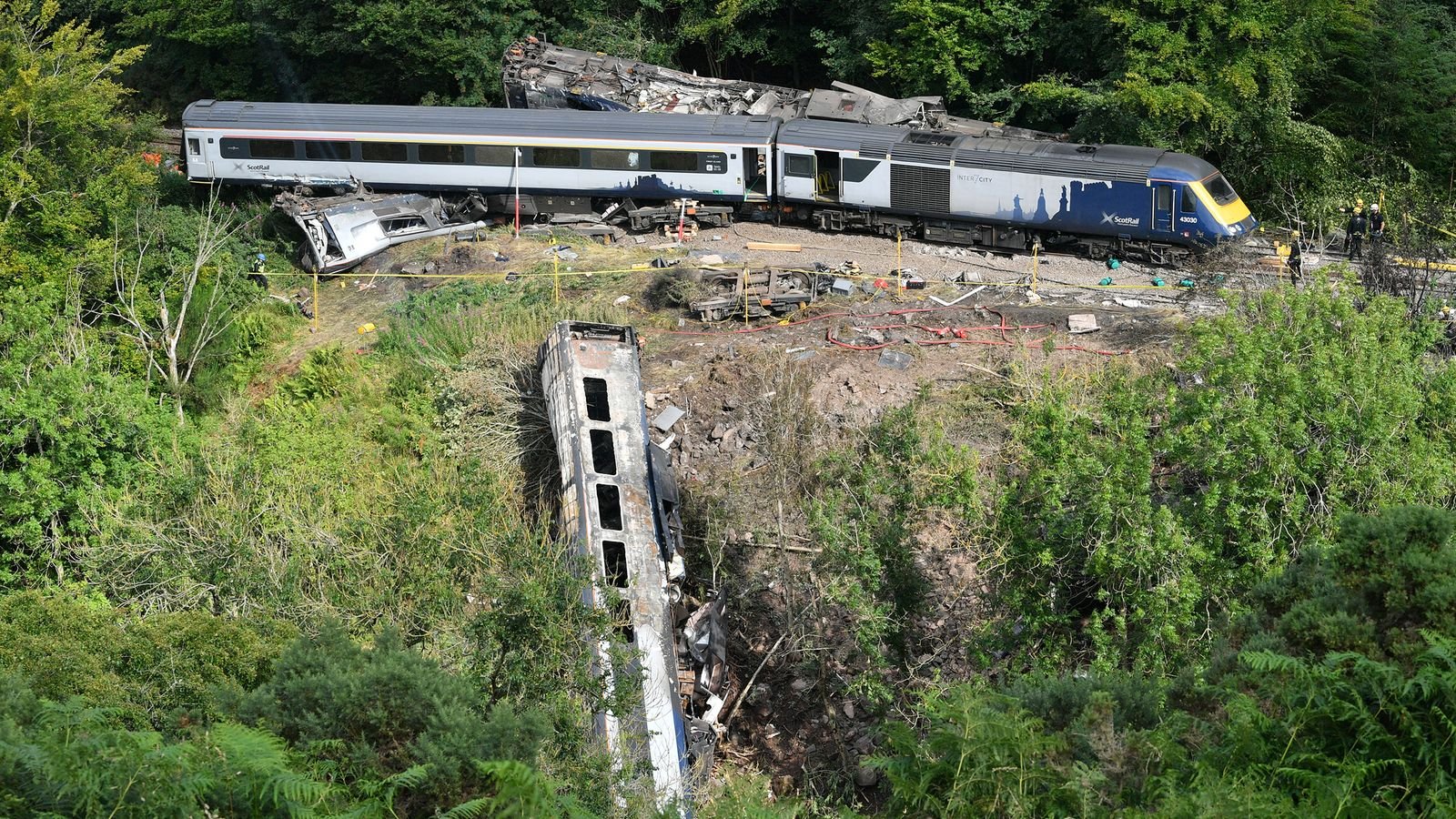
Inquiry Reveals Reliance on Faulty Contractor in Fatal Train Derailment
An inquiry into a tragic train derailment in Scotland has revealed that Network Rail depended too heavily on its contractor, Carillion, which constructed a faulty drainage system. The incident, which occurred on 12 August 2020 near Stonehaven in Aberdeenshire, resulted in the deaths of three individuals, including the train driver and a conductor, while injuring several others.
Details of the Incident
On the day of the accident, a ScotRail service travelling from Aberdeen to Glasgow derailed after encountering a pile of gravel washed onto the tracks due to heavy rainfall. The subsequent collision with a bridge barrier led to a devastating outcome, with the train driver Brett McCullough, conductor Donald Dinnie, and passenger Christopher Stuchbury losing their lives. Stuchbury’s wife expressed that the tragedy stole their future together, marking the day as their wedding anniversary.
Investigation Findings
According to Nick Bucknall, an inspector from the Rail Accident Investigation Branch (RAIB), the number of casualties might have been significantly higher if the train had been at full capacity, a situation influenced by the reduced passenger numbers due to the COVID-19 pandemic.
The inquiry revealed that the drainage system constructed by Carillion did not meet agreed design specifications, thus failing to handle the rainfall that day. Bucknall noted that this oversight could have been mitigated if Network Rail had followed proper procedures for transferring safety-related information. He criticized the inefficacy of this transfer, suggesting that if it had been appropriately managed, discrepancies between the design and actual construction might have been recognized and rectified.
Issues with Contractor Oversight
William McKay, who served as Network Rail’s project manager on the drainage project, acknowledged that Carillion was permitted to “self-assure” the quality of its work as a “large, competent contractor.” He conceded that Carillion did not provide the legally required “health and safety file” at project completion, which should have contained crucial documentation regarding the actual build.
Sheriff Lesley Johnson raised questions about whether Network Rail had placed excessive trust in Carillion, insinuating that a lack of proper oversight had enabled the contractor to essentially evaluate its own performance.
Preventive Measures Implemented
In the wake of the tragedy, improvements have been made to the railway infrastructure. A new drainage system that can manage heavier water flow has been constructed at the crash site. Additionally, guard rails have been installed to deter a partially derailed train from colliding with nearby structures. A new position for a dedicated weather desk has also been introduced, tasked with real-time monitoring of weather conditions to inform safety protocols.
Safety Standards Concerns
Dominique Louis, a principal inspector at RAIB, highlighted that the coaches involved in the incident lacked several safety features now standard in modern trains. He noted that the crash’s outcome could have been less severe had the train complied with current crashworthiness standards. At the time of the accident, the train was travelling just below the normal speed limit for that section of the track.
Legal and Fiscal Consequences
In 2023, Network Rail faced legal repercussions, being fined £6.7 million after admitting to breaches of health and safety regulations that contributed to the deaths. Nearly £1 million in damages was also awarded to seven individuals impacted by the incident. Meanwhile, Carillion, which entered compulsory liquidation in January 2018, has not been implicated in these ongoing inquiries.
Background
This incident is particularly significant within the broader context of railway safety in the UK, as it raises questions about contractor management, regulatory practices, and the adequacy of preventative measures in place to protect both passengers and railway workers.
The ongoing inquiry continues under Sheriff Lesley Johnson, aiming to pinpoint further accountability and improvements in UK rail safety standards.
Source: Original Article






