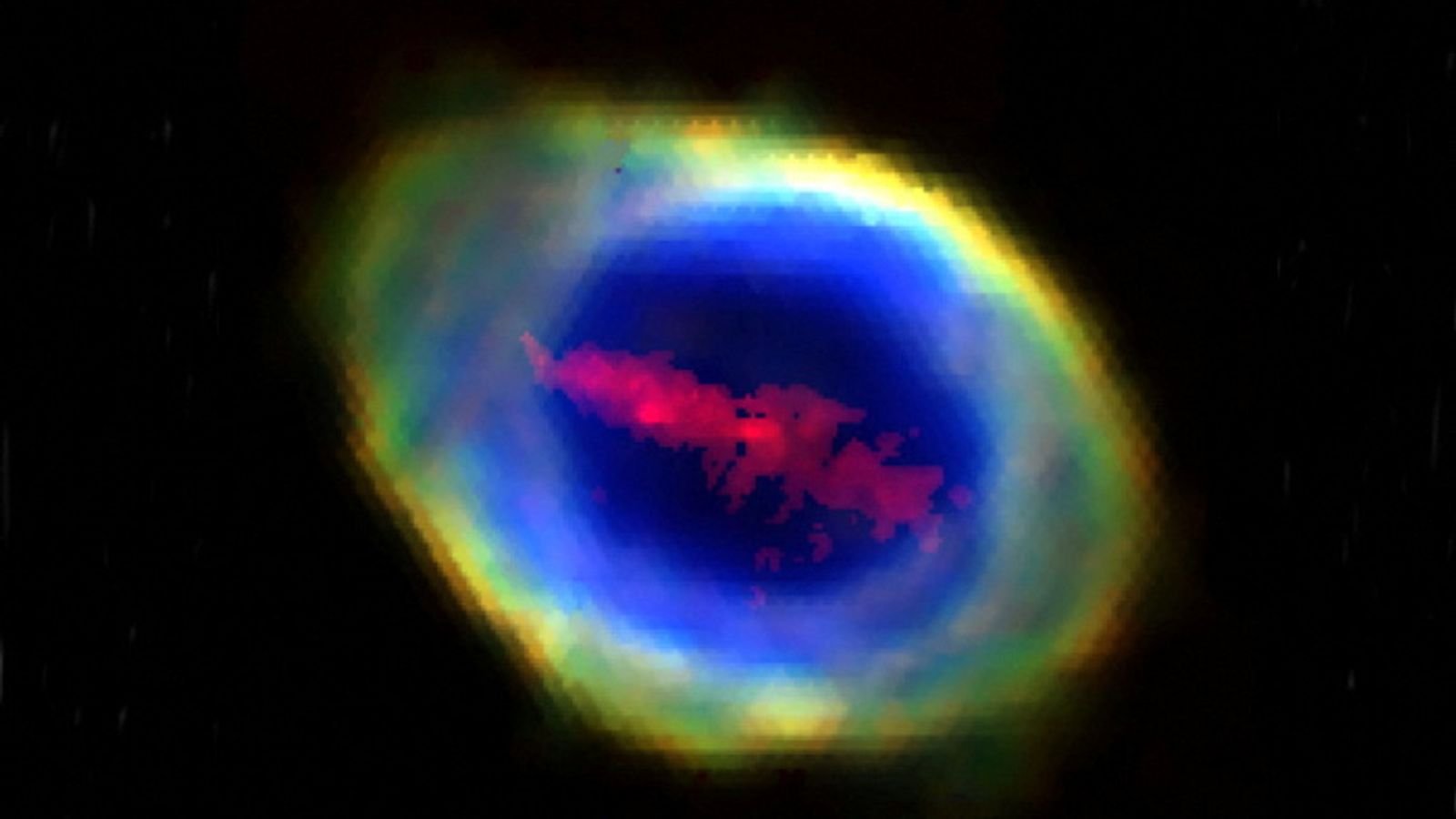
Mysterious Bar-Shaped Cloud Discovered in the Ring Nebula
Astronomers have recently identified an enigmatic cloud within the Ring Nebula, also referred to as Messier 57. This striking nebula, located approximately 2,600 light-years from Earth in the constellation Lyra, is known for being the luminous aftermath of a former sun-like star.
Possible Remnants of a Vaporised Planet
Researchers theorise that the unusual iron atom structure, shaped like a bar, may represent the remnants of a rocky planet. This celestial body could have been completely vaporised as the star shed its outer layers during its life cycle. The significance of such a finding raises intriguing questions about the fate of Earth when the sun undergoes a similar transformative process billions of years from now.
A Colossal Dimension
The newly observed iron cloud spans an impressive 3.7 trillion miles (or approximately six trillion kilometres) across the nebula. Since its discovery by French astronomer Charles Messier in 1779, the Ring Nebula has been a subject of intensive study in the astronomical community.
New Observations via Advanced Technology
This remarkable observation was achieved using WEAVE, the WHT Enhanced Area Velocity Explorer, on the William Herschel Telescope in La Palma, Canary Islands. Astronomer Roger Wesson, affiliated with Cardiff University and University College London, expressed excitement over this unexpected find: “It is exhilarating to note that even well-explored celestial objects can reveal surprises when observed with new tools.”
Published Insights
The findings have been documented in the journal Monthly Notices of the Royal Astronomical Society. The Ring Nebula is believed to have formed around 4,000 years ago, a relatively recent event in the vast timeline of the universe, and is primarily composed of hydrogen and helium.
Formation and Composition of the Ring Nebula
The nebula originated when a star approximately twice the mass of the sun exhausted its nuclear fuel, expanding into a red giant phase. Following this expansion, it expelled its outer layers and ultimately left behind a compact stellar remnant known as a white dwarf, comparable in size to our planet.
Controversial Observations
Janet Drew, a co-author of the study from University College London, voiced curiosity about the iron cloud, stating, “No other chemical element we have detected seems to share this bar-like formation. This is genuinely puzzling.” She suggested that while the iron could originate from the destruction of a planet, other explanations for its formation could also be explored.
A Broader Context
The discovery adds to the knowledge surrounding approximately 3,000 known nebulae in our galaxy. Understanding these structures contributes significantly to astronomers’ ability to study the various life stages of stars, thereby enhancing our comprehension of cosmic evolution.
As scientists continue to unravel the mysteries of the universe, findings like this one highlight the complexities and surprises that celestial observations can unveil, fostering an ongoing fascination with the cosmos.
Source: Original Article