Escalating Conflict Forces Evacuations in Aleppo
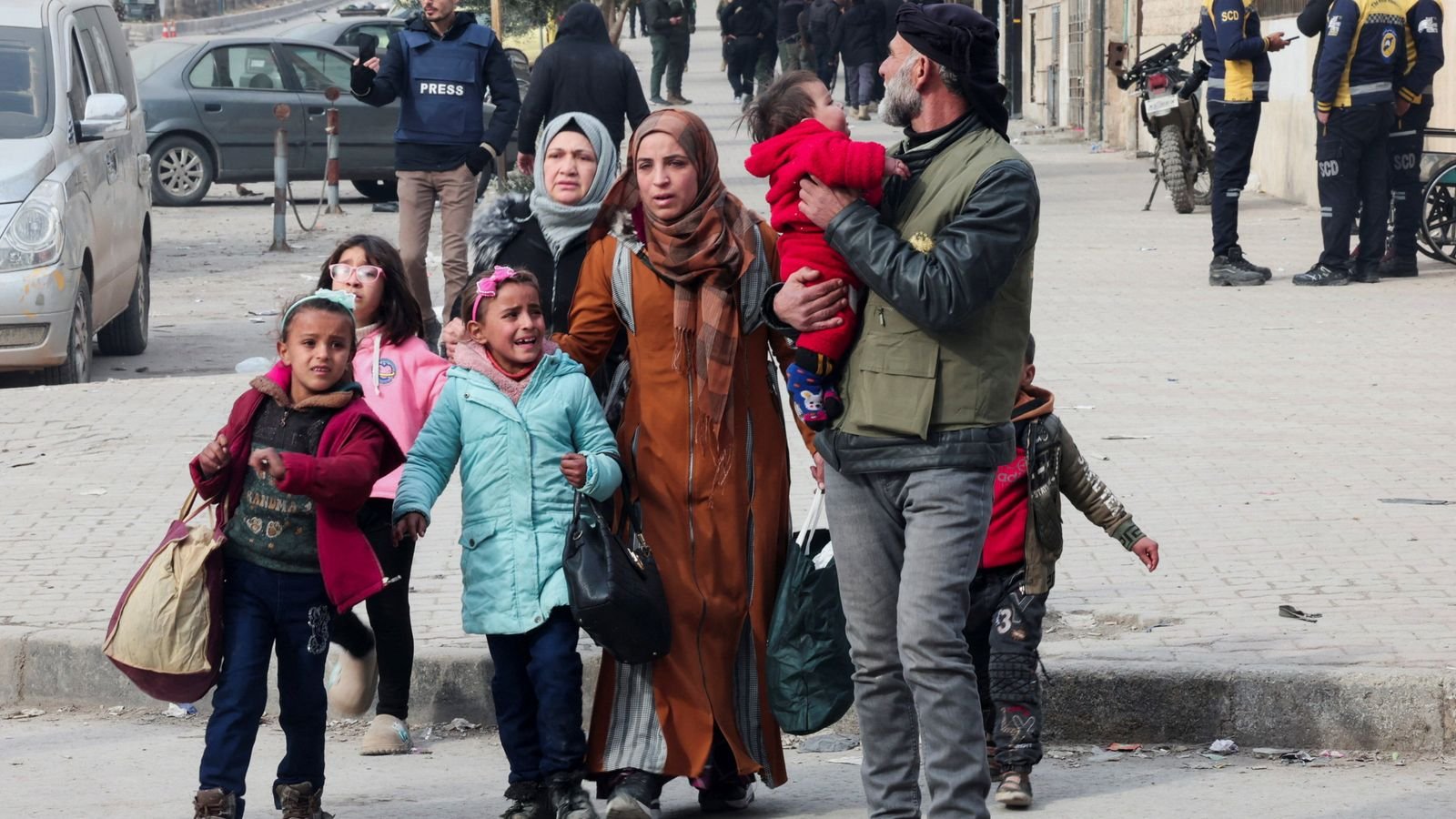
In Aleppo, thousands of residents have been compelled to leave their homes following a government directive amid renewed clashes between the Syrian army and Kurdish forces. The provincial administration set a deadline for evacuations, aiming to provide safe passage for civilians from Kurdish-controlled areas, as military operations intensify in the region.
Government Mandates Evacuations
The provincial authorities announced that residents in Kurdish-majority areas must evacuate by 1pm local time on Thursday. They provided specific evacuation corridors to facilitate the movement of civilians, and subsequently issued maps delineating areas designated as no-go zones. In response to the ongoing unrest, the Syrian military announced plans to commence “targeted operations” against the Syrian Democratic Forces (SDF) in the districts of Sheikh Maqsoud, Achrafieh, and Bani Zaid.
Intensified Fighting and Humanitarian Impact
Fighting has escalated significantly since it erupted earlier this week, coinciding with the SDF’s ongoing refusal to fully integrate into the Syrian army following the overthrow of President Bashar al-Assad in late 2024. The SDF has reported heavy clashes with government-aligned factions, claiming that at least eight civilians have lost their lives in the Kurdish neighbourhoods due to the violence. They further allege that the government’s shelling constitutes forced displacement and potential war crimes.
Government sources have confirmed the deaths of at least seven civilians and one soldier in areas under their control. Nearly 140,000 individuals have reportedly been displaced throughout Aleppo province as a result of the escalating conflict, according to local social affairs officials.
Impact on the Local Population
Mohammad Ali, operations director with Aleppo’s Syrian Civil Defence, highlighted the plight of those fleeing. He indicated that many of the displaced include vulnerable groups such as women, children, and the elderly, a significant proportion of whom are facing serious medical challenges.
Regional Context and International Response
The SDF has maintained significant control over much of northeastern Syria and has been a key ally of the United States in combating the Islamic State group. Tensions arose following a deal in March, which aimed for the complete integration of SDF forces into the Syrian military by the end of 2025. However, progress on this front has been sluggish, with both parties alleging obstruction from one another.
There are growing concerns that failure to achieve integration could lead to increased violence and provoke military intervention from Turkey. Ankara considers the Kurdish fighters as terrorists due to their connection to the Kurdistan Workers Party (PKK), which has led a prolonged insurgency within Turkey.
Calls for De-escalation
International stakeholders have urged all parties involved to exercise restraint and seek de-escalation of hostilities. A spokesperson for the US State Department reported that the situation is being closely monitored, while UN representative Stephane Dujarric expressed alarm over civilian casualties. He called for immediate measures to protect civilians and mitigate further harm.
Background
The conflict in Syria has persisted for over a decade, with various factions vying for control after the initial uprising against President Assad in 2011. The rise of the SDF as a significant force in the region has complicated the power dynamics, especially as external influences such as the US and Turkey engage in diplomatic efforts to stabilize the area. The current escalation in Aleppo underscores ongoing tensions and the precarious nature of peace in Syria.
Source: Original Article