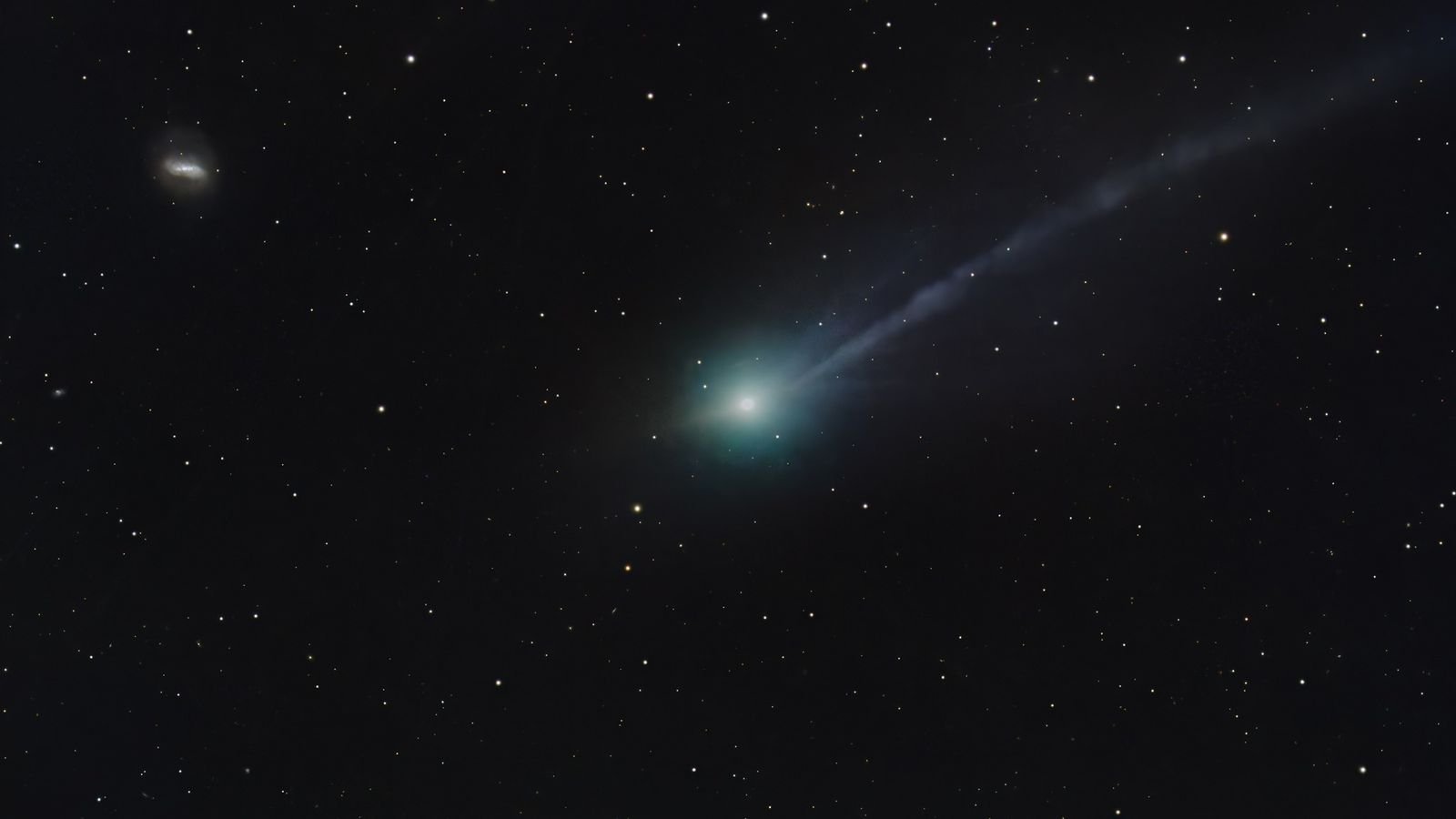
Mysterious Object Approaches Earth, Sparking Alien Theories
A controversial claim is making waves as a mysterious celestial object, named 3i/ATLAS, approaches its closest encounter with Earth. Set to pass by at approximately 170 million miles away—a distance nearly double that of the sun—this rapidly moving entity is travelling at an astounding speed of 130,000 miles per hour. While most astronomers agree it is a comet originating from outside our solar system, one prominent scientist has ignited a debate by suggesting it could potentially signify an extraterrestrial visitation.
Background of the Discovery
First identified in July as a faint dot in the night sky, 3i/ATLAS has since traversed our solar system, having already passed Mars and briefly obscured by the sun. Following its close encounter with Earth, it is expected to move towards Jupiter before vanishing from sight again. Both NASA and European space agencies have focused numerous instruments on the object and maintain that its existence is purely a natural phenomenon.
Controversial Claims by Professor Loeb
Professor Avi Loeb from Harvard University has expressed caution over the object, characterising it as a potential “black swan event”—an occurrence that is improbable yet could carry significant implications. “Alien technology poses a potential risk because, in cosmic encounters, we cannot predict whether we are greeting a benevolent being or an adversary,” he stated. Loeb further pointed out features such as the object’s unusual tail, which he suggests might indicate the presence of a propulsion system, and traces of nickel in its gas cloud that could hint at resource extraction.
Loeb believes society must remain vigilant and urges that all possibilities, even those considered far-fetched, warrant investigation. He critiques mainstream scientific thinking for its dismissal of alternative explanations.
Scientific Consensus
In contrast, experts like Professor Chris Lintott from the University of Oxford have dismissed Loeb’s hypotheses. Lintott likened the idea of alien technology to the absurd notion that the moon is composed of cheese. He argues that observed changes in the object’s brightness and color can simply be attributed to solar heating affecting its icy components and various materials acquired during its journey.
Amit Kshatriya from NASA sums up the prevailing view among astronomers: “This object behaves like a comet, and all evidence supports this assessment.” Despite differing perspectives, the broader scientific community continues to advocate for a rational approach to the anomaly.
Conclusion
The debate surrounding 3i/ATLAS reflects a long-standing fascination with the unknown, particularly in the context of extraterrestrial life. As it nears Earth, it prompts not only scientific inquiry but also public curiosity about what, if anything, lies beyond our own world. As this extraordinary celestial entity continues its course, scientists remain intent on monitoring its trajectory and characteristics.
Source: Original Article